Learn how TIAS Business School replaced a fragmented CMS with a composable stack — unlocking faster content and 19% organic traffic growth.
Education
This is a preview of the Storyblok Website with Draft Content
JoyConf 2026 is back. Content Confidence. Human Connection. Save your spot!
Running a university website isn’t like managing a typical corporate site. In many ways, it’s closer to running a small digital town. Thousands of pages, hundreds of editors, and dozens of departments — each with their own priorities, audiences, and content needs. Older, outdated legacy systems sit alongside new tools, and as in any growing town, people are quick to notice when the infrastructure starts to fall behind.
Meanwhile, higher education is rapidly evolving. Marketing teams now operate in an environment shaped by AI, real-time data, hyper-personalization, and changing privacy expectations.
For the University of East Anglia (UEA) (opens in a new window), keeping pace with this shift meant rethinking how its digital experience was built and managed. The university’s legacy CMS struggled to support the scale, flexibility, and editorial independence the organization required.
To move forward, UEA rebuilt its digital platform using a headless architecture powered by Storyblok, Next.js, and AWS — creating a faster, more flexible foundation for both developers and content teams.
UEA’s digital team sits at the center of the university’s marketing and recruitment efforts — what Paul Napleton, Head of Digital and Marketing Automation at UEA, describes as “the digital engine room that helps our division achieve its recruitment and reputation plans.”
The team manages the university website and its internal portal (intranet), alongside responsibilities for SEO, accessibility, analytics, and digital best practice. They also run a service desk supporting editors across the university and work closely with the IT department to keep the platform evolving.
And that’s only part of the picture. Marketing automation, CRM integrations, peer-to-peer student communities, and experimentation with emerging technologies all feed into a growing digital ecosystem designed to better understand and engage prospective students.
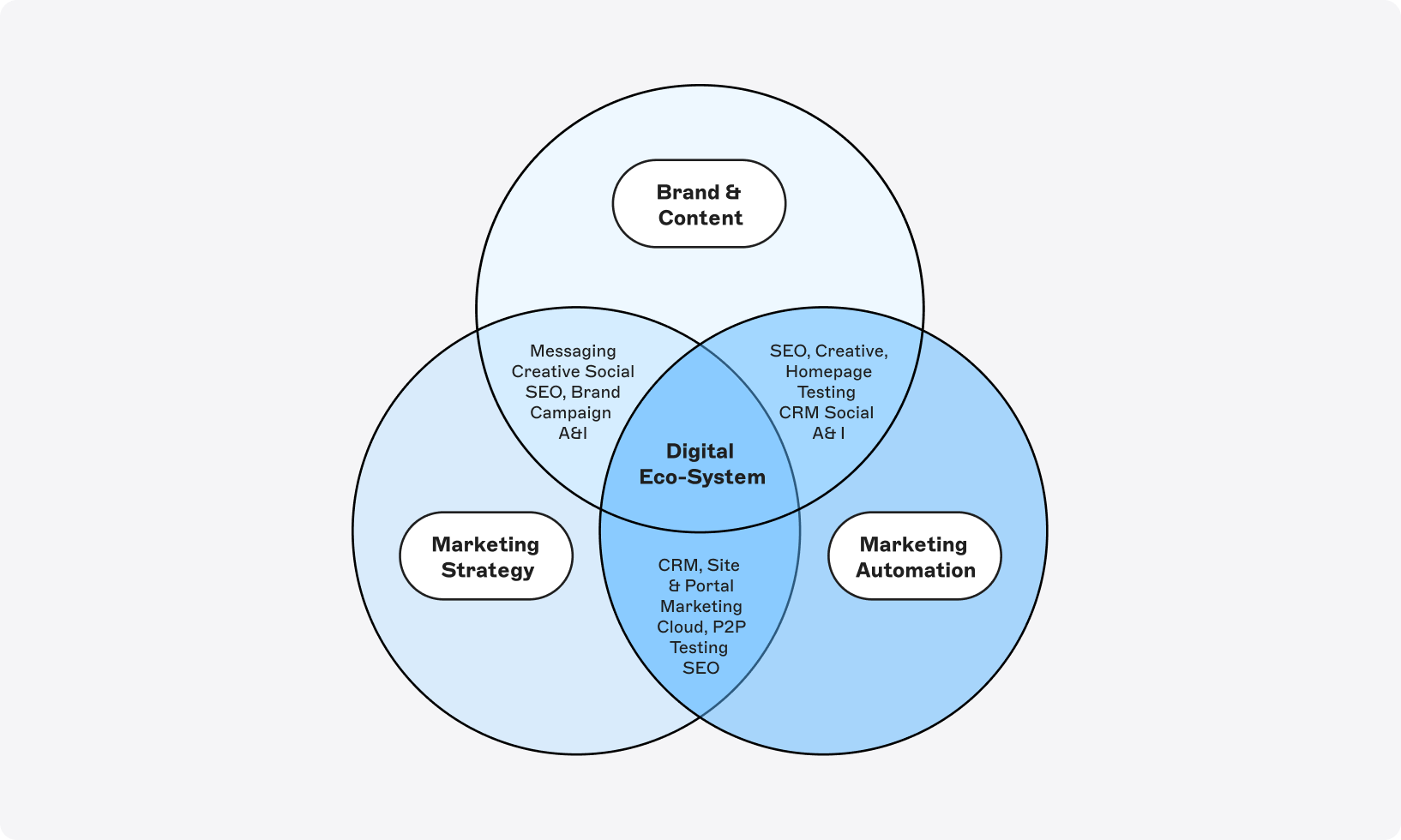
But while digital ambitions were expanding, the technology behind the university’s web presence had begun to show its age. The previous portal-based CMS could serve information, but it struggled to support the needs of a modern university website.
Across the university, those limitations showed up in practical ways:
The infrastructure behind the platform also required constant attention. During peak traffic periods, the team often had to manually monitor servers to prevent outages.
Those challenges were not just internal. They also affected the visitor experience:
Modernizing the university’s web platform became part of a broader transformation aimed at improving the digital infrastructure behind its online presence. The initiative evolved into a multi-year program focused on connecting the university’s digital systems — from course catalogues and news platforms to the infrastructure delivering the website itself.
The change had to happen while the university continued operating as usual. Recruitment campaigns run year-round, so the existing platform still had to support marketing activity while the team worked to replace it.
The shift also required teams to adapt. Developers were retrained, roles evolved, and the team gradually prepared for a more modern web architecture. Senior leadership support helped accelerate that transition, with additional budget enabling the team to grow and bring in developers experienced in modern JavaScript frameworks.
With the team in place, attention turned to the technology stack that would power UEA’s future digital platform:
UEA needed a CMS that could integrate cleanly with its new stack while simplifying content management for the many editors maintaining pages across the university.
Several headless CMS platforms were evaluated before the shortlist narrowed to Contentful and Storyblok. The team defined a clear set of priorities:
During the evaluation process, the team trialed Storyblok by building several pages on the platform. It quickly became clear that it aligned well with the university’s technical architecture, governance requirements, and editorial workflows.
Storyblok’s live preview was one of the biggest features for us, along with how easy it was to work with from both the development and editorial side.

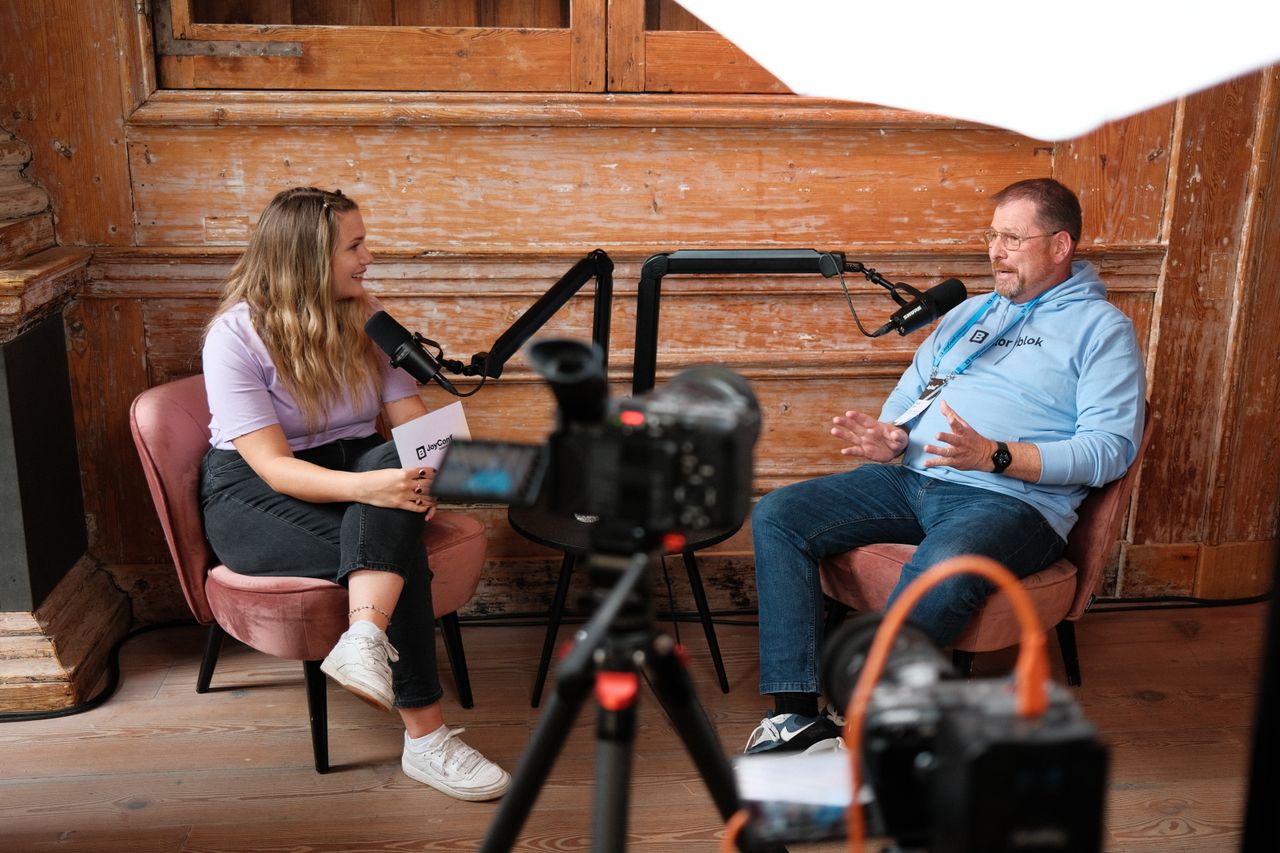
In this JoyConf interview, Alistair shares why Storyblok’s passion and product innovation have been key to UEA’s growth, and celebrates becoming a 2026 Storyblok MVP.
Alistair Quinn - Senior Technical Lead at UEA
Maria Baumgartner - Customer Experience Marketing Manager at Storyblok


Modernizing the university’s digital platform required close collaboration between marketing and IT.
Historically, that relationship had often been shaped by the limitations of the previous platform. The transformation created an opportunity to reset that dynamic. As the new platform took shape, both teams worked closely together to define the future website, combining technical architecture with a refreshed brand and user experience.
Because much of the work was happening behind the scenes, the development team focused on demonstrating progress through prototypes and early pages. Showing what the new platform could do helped build confidence and buy-in across teams.
Over time, the relationship between marketing and IT became more collaborative, supported by agile ways of working that combined Kanban for day-to-day delivery with Scrum for larger projects.
Technology works best when it enables people and teams to achieve more together. Collaboration is one of UEA’s longstanding brand values, and this project really brought that to life as our ITCS and Admissions, Recruitment and Marketing teams worked closely together to unlock the potential of the new platform.

Marketing and IT often approach problems from different angles. The key is having open, honest conversations and building trust between teams. When you deliver the right product, that relationship becomes much easier.
With Storyblok powering the content layer and a composable architecture built on Next.js and AWS, the new platform quickly proved its value across the university’s digital ecosystem.
Today, more than 340 editors manage content across UEA’s marketing website and internal portal, each with clearly defined permissions and editing areas. That structure allows teams across the university to manage content more confidently, while reusable components help maintain consistency, governance, and accessibility standards across the platform.
With Storyblok, faculties, departments, and professional services teams can manage content much more independently. That has reduced reliance on central IT while helping us maintain stronger governance, consistency, and accessibility across the site.

Publishing cycles have also become much shorter, helping teams respond more quickly during high-pressure periods such as Clearing, the UK university admissions period when students secure last-minute places.
That increased agility was reflected in the performance of the first Storyblok-powered pages. During the first year after launching the new Clearing pages, activity increased dramatically.
On our Clearing pages in the first year alone, activity increased by 4,000%. It was such a big number that our third-party analytics team checked the code because they thought we’d made a mistake.
As the full website rollout progressed, engagement across the site continued to grow.
The new composable architecture significantly improved platform reliability. Previously, traffic spikes during key recruitment periods could push the infrastructure to its limits.
Today, the site runs on a serverless AWS architecture that scales automatically with demand. Over an 18-month period following the migration, the platform experienced just four minutes of downtime while supporting thousands of concurrent users during peak traffic periods.
Performance improvements have also transformed the experience for international visitors. Under the previous infrastructure, prospective students outside the UK sometimes faced page load times of 20–30 seconds or even timeouts. Today, the homepage loads in under five seconds globally, dramatically improving accessibility and user experience.
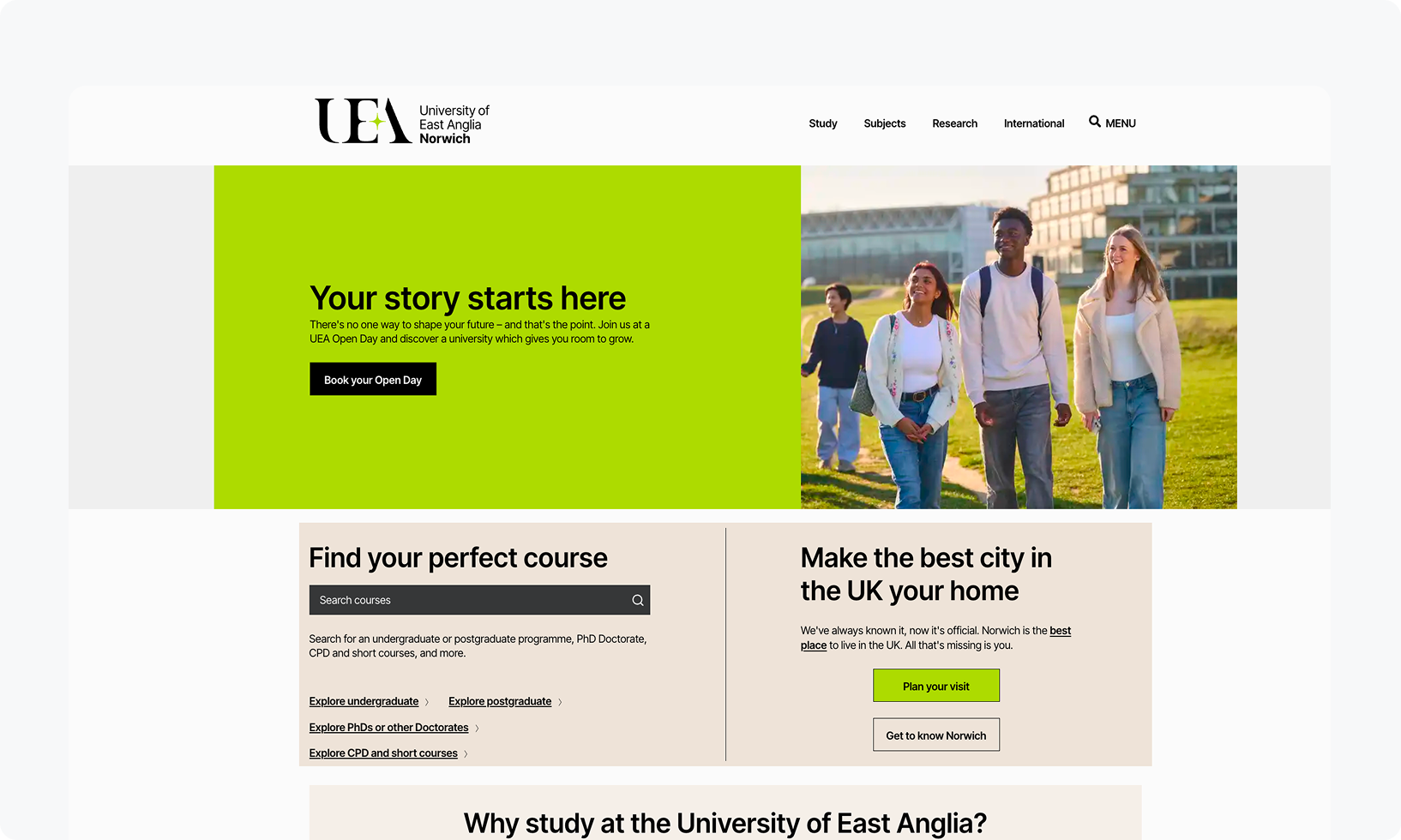
Alongside these performance gains, the website relaunch introduced a refreshed design and clearer user journeys across key pages. The updated homepage features simplified messaging, improved navigation, and more focused calls to action, helping prospective students find key information more quickly.
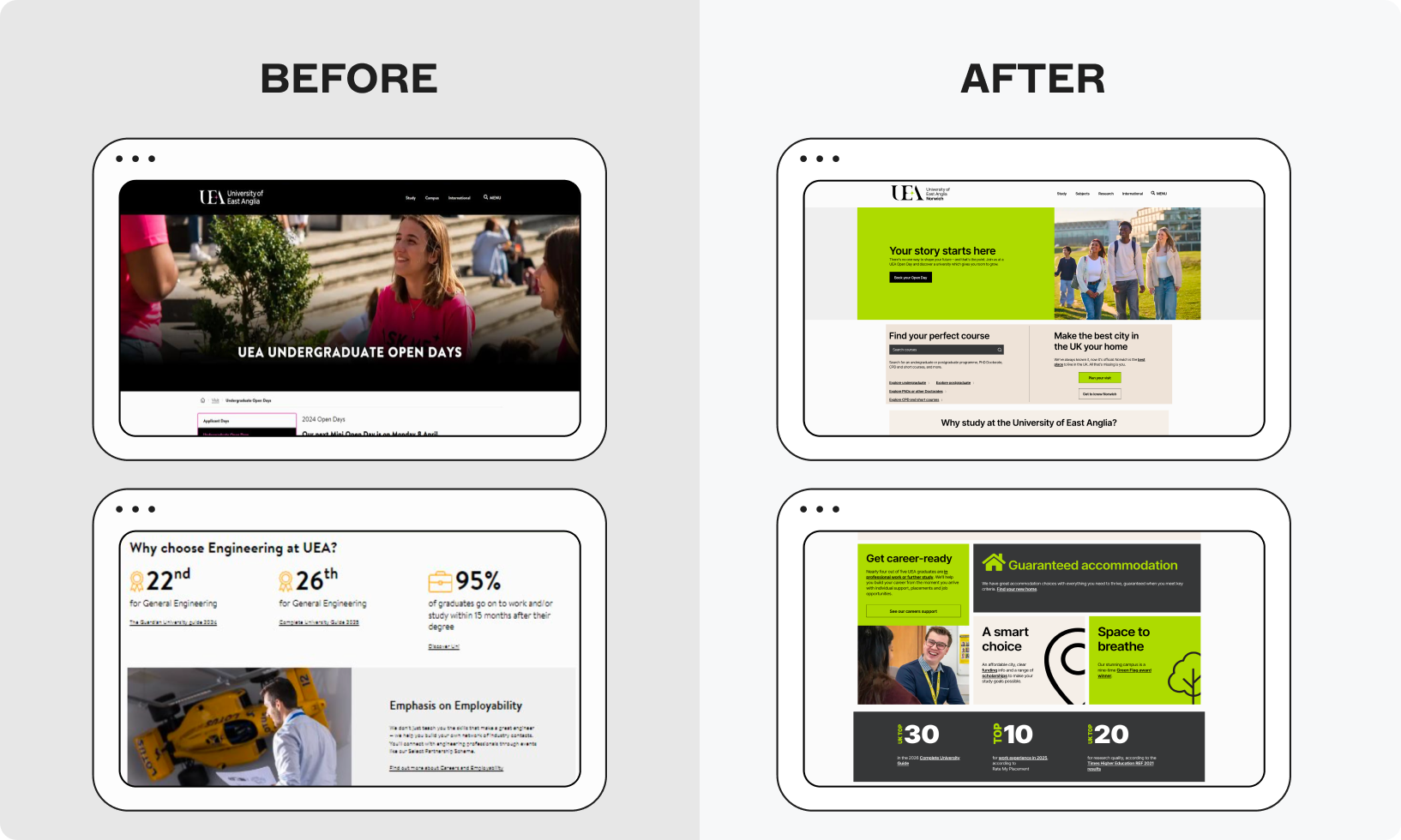
We used to monitor servers constantly during busy periods. Now we monitor the website for users, not failures.
The move to Storyblok has been night and day in terms of what we're able to do. From stability and speed to accessibility and mobile performance — it’s been a real step change.
For universities considering a move to a headless CMS, the team at UEA highlights several lessons from its experience. The transformation worked because it was treated as a cross-functional initiative rather than a purely technical one, with marketing and IT aligned around the student experience from the start. It also showed the value of giving distributed teams more independence while maintaining governance through reusable components and shared standards. And beyond publishing and performance, the migration gave the IT team greater confidence in the platform’s long-term security, compliance, and maintainability.
We didn’t treat this as just an IT migration. Marketing and technology worked closely together from the start, focusing on the student experience as well as the platform benefits.
Cybersecurity is an increasing concern for our IT department. The move has brought us to a place where the website is far more secure and compliant. It’s given our IT team much greater confidence in the platform.
By combining a modern headless architecture with close collaboration between marketing and IT, UEA built a platform that can support the scale and complexity of its digital ecosystem — while giving teams across the university more flexibility to keep improving the student experience.