Grokdon RamsayBot and the Agentic Kitchen

Storyblok is the first headless CMS that works for developers & marketers alike.
“This isn't a schema, this is a MISTAKE. It reads like a lost tourist's menu. My gran could name components better than that!“ - Grokdon RamsayBot, Executive Chef at the Agentic Kitchen.
That is what happens when you take “cooking up a site” literally.
A modern multi-agent system is a lot like a kitchen, in that all workers have their own specialized roles and work concurrently to achieve their output, ultimately delivering the final, ordered dish.
Usually, this means picking a framework, connecting services, managing credentials, memory, plugins, skills, etc. And now, with services like Grok Bot, this multi-agent setup can be created, managed, and connected with plain English.
Can Grok Bot be used to successfully create an agentic kitchen that takes a product brief and design guidelines to create a new Storyblok page, front to back?
What is Grok Bot?
Grok Bot is xAI's team of always-on AI agents, launched in beta on August 11, 2026. Each bot works on its own persistent cloud computer with a browser, filesystem, and terminal, so it signs into the tools you already use and finishes the work there, even with your laptop closed.
Grok Bot differs from a chatbot in three ways:
- Bots keep context. A named bot keeps its memory, files, browser sessions, and preferences across sessions.
- Bots learn workflows. Walk a bot through a multi-step task once, and it saves the path as a skill it can rerun on a schedule.
- Bots work as a team. Bots run in parallel, message each other, share context in group chats, and pass ownership of a task. Inside xAI, teams often put a Chief of Staff bot above specialist bots for inbox management, recruiting, expenses, and bug fixes.
The agentic kitchen uses that same shape: Grokdon is the Chief of Staff, and every other station is a specialist.
For setup details, read the Grok Bot overview in the xAI docs.
Where does an agentic kitchen sit on the AI maturity curve?
xAI frames Grok Bot with an AI maturity curve:
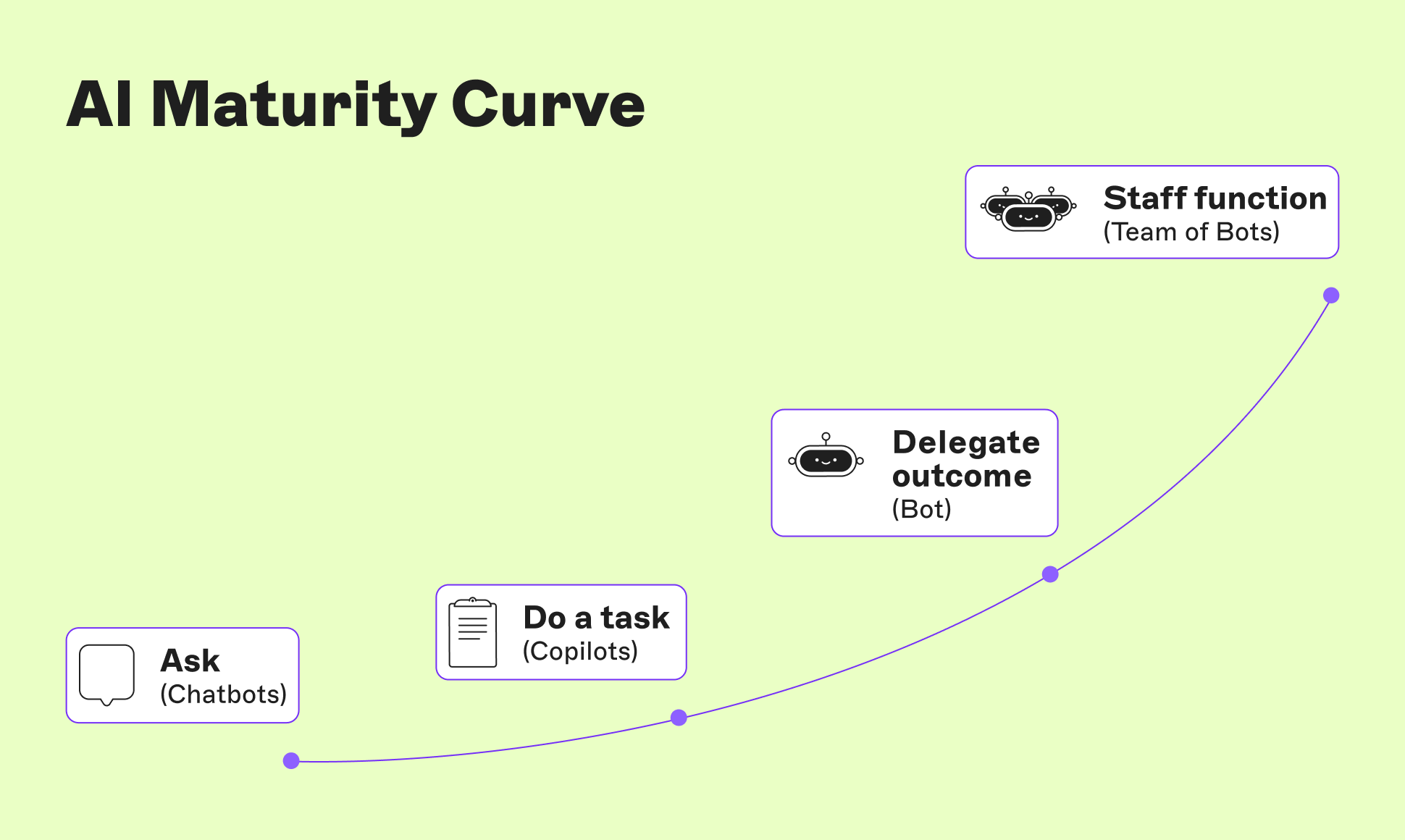
This is a rendition of a graph created by xAI.
Each stage hands more of the work to the AI:
- Ask (chatbots). You ask a question and get an answer. You still do the work.
- Do a task (copilots). The AI completes a bounded task next to you, like writing a function in your editor. You still decide every step.
- Delegate outcome (bot). You hand over the result you want, not the steps. One bot owns the job end to end.
- Staff function (team of bots). A group of bots covers a whole function, with one coordinating the rest.
The agentic kitchen sits at the top of the curve. The input is a product brief, and the output is a live, localized Storyblok page, with design, copy, localization, and engineering each owned by a different bot. The higher stages don't remove the human, though. As the rest of this article shows, the kitchen still needed a person to design the bots, for authentication, naming rules, review and validation, and debugging.
Meet the agentic kitchen teammates
Each station is a separate AI agent with its own persona and its own job. The personas make it obvious who's talking and keep each agent in its lane.
Grokdon RamsayBot: Executive Chef and point of contact (Chief of Staff)
Grokdon is the only agent you directly interface with. Every station routes through it. It opens tickets, delegates tasks, generates product images, and uses the GitHub and Vercel connectors to diagnose deploys. Voice: full Hell's Kitchen Gordon Ramsay, Stratford-upon-Avon Midlands accent, profanity OFF.
Inès: Chef de Cuisine, (Design)
Inès loads Anthropic's frontend-design skills and designs the desired page(s) following the desired direction.
Étienne: Sommelier, (Writer)
Étienne writes default English content into Storyblok through MCP. Before publishing, it runs the humanizer skill.
Mateo: Regional Menu Developer, (Localization)
Mateo starts once English is published. It localizes content to the desired locales while avoiding calques.
Céline: Sous Chef, (Engineer/Developer)
Céline loads Storyblok skills, the Next.js next-dev-loop skill, and uses them alongside the Storyblok MCP and CLI to create a Next.js project, model and integrate the Storyblok schema, and makes PRs.
How does the kitchen interact?
The user talks only to Grokdon. Stations message Grokdon, Grokdon notifies the user when a taks is completed, relays messages from other stations, and asks when clarification or authentication is needed, and Grokdon relays back to the correct station.
Here's how it looked:
1. The brief (Human → Grokdon)
Human: Blok Clad: luxury landing, design, English, Spanish, and Japanese, build it, generate the images. (Brief summarized)
Grokdon: RIGHT. Ten pieces, three countries, ONE launch day. Brief's on the pass. Read it ONCE, then cook. Inès, design. Étienne, English. Mateo, wait for English. Céline, stand by to build. And nobody, NOBODY, goes near the raw Management API. Don't just stand there like a big muffin. MOVE!
2. Design (Inès → Grokdon)
Inès: Design Read: premium cookware, calm luxury, photography leads. Mise is set. Plaster #F7F4F0, graphite ink, soft stone. Copper is a garnish: copper-band finish only, never a button. I've cut the identical triple cards and the purple glow. Taste it before you plate it. Quiet Heat is locked.
Grokdon: Now THAT'S how you do it. Calm plate. Copper on the garnish, not all over the sauce. Well done.
3. Development (Human → Grokdon → Céline)
Human: The components shouldn’t start with plp_. No invented prefixes, name the components only after their purpose - follow the naming convention in skills.
Grokdon: You heard him. plp_hero? plp_inbox? This isn't a schema, this is a MISTAKE. It reads like a lost tourist's menu. My gran could name components better than that! PLAIN NAMES. landing_page. hero. waitlist. Céline, schema FIRST, then we fill it. Don't take it personally. Take it seriously.
Céline: DONE. Halted the plp_* batch before it fired. landing_page plus 17 plain nestables created, zero errors. Empty story blok-clad is ready. Four assets untouched. Étienne is clear to fill.
4. Content (Étienne → Grokdon)
Étienne: Published, Chef. The first pour had too much oak: em dashes everywhere, three-item lists stacked up like a showy wine flight. The humanizer cut them. The nose is clean now. "Stainless that heats as evenly as it sears." Prices, specs, and Aiko's honest four stars are all untouched. Spanish and Japanese are left open for Mateo.
5. Localization (Mateo → Grokdon)
Mateo: Spanish and Japanese are live. And no, I did not write "sartén de 10 pulgadas" for a cook in Guadalajara. That's a calque, a tourist with a phrasebook. It's 25 cm. 500°F is 260 °C. Mexican Spanish that sounds like Mexico, Japanese that sounds like Japan. Prices stay in dollars, Aiko's four stars stay four. I translate the place, not the dictionary.
6. Deployment Stuck (Céline → Grokdon → Human)
Céline: BLOCKED. PR #1 is on main, but production is still serving the old branch build. Deploy from main returned 403 on team scope. I need a re-auth or a dashboard promote.
Grokdon: WHERE'S THE PLATE?! It's cooked, it's on main, and it's sitting under the heat lamp going cold! User, the Vercel connector needs you to authenticate for that team, or we promote from the dashboard. One tap, Chef.
7. Bug triage (Grokdon → Céline)
Grokdon: The page paints, but the editor says "Component landing_page doesn't exist." Doesn't EXIST? I'm LOOKING at it! Find it. Find it, find it, FIND IT!
Céline: DONE. Cause: the client StoryblokBridge imported the server-side (RSC) storyblokInit, so the client registry was empty. Fix: pure components map, separate server-only init. The Bridge touches only the map. PR #2 merged, prod READY, EN/ES/JA 200, overlay gone.
Grokdon: Now THAT'S how you do it. The Bridge stays out of the RSC pantry. Proud of you.
Building the kitchen
An official bot from the xAI marketplace, dr eggbot was used to help design bots and voice routing for the kitchen. Dr eggbot was given the description of the desired bot’s role in operational terms, including: the goal, set of tools and sources, working style, approval boundary, and persona — this follows xAI best practice. As you will read later, this doesn’t necessarily mean the bot is complete or perfect — iteration and further instruction are needed.
Getting the agents to communicate was done by adding who it should communicate with to their instructions. They were even able to share a desktop and work together after being prompted to do so.
Running the Kitchen
The kitchen didn’t work perfectly on the first try. It failed to successfully turn a product brief into complete, working landing page using Storyblok and best practices.
The Storyblok MCP was ignored
The first attempt was unsuccessful as the skills were ignored and the Storyblok MCP was not used. Authentication failed, because OAuth for the MCP is currently only supported via Claude. Grokdon asked for a PAT, but once provided, even though it was meant to authenticate to the MCP, it was used to complete everything via the MAPI. This ignored skills and the benefits of using the Storyblok MCP. The outcome was a poorly created page with empty components.
It required another iteration, but once the bots system instructions were updated to ONLY EVER USE THE STORYBLOK MCP, this changed. Céline successfully applied the skills and used the MCP, to create a well modeled, well designed, interactive product drop page. It also applied the next-dev-loop skill and would prove a change actually works in a RUNNING app, not just that it compiles.
The CLI scaffold was skipped
When creating a new Next.js project, it created it from scratch instead of using a Storyblok template because the target GitHub repository was provided, so the skill telling it to use the CLI create was ignored. The skills had to be extended to support working with Grok Bot and its limitations.
The Chief of Staff redirected requests
In the initial two passes the chief of staff did not handle everything. It would redirect the user to the requesting/working bot to interact with it (ex: Céline needed authentication to the MCP). With a change of instruction defining the chief of staff as front-of-door with all requests going through it, and a glass kitchen policy, meaning all data is shared between agents so they can reconstruct/access generated data, this improved, and all requests went through Grokdon Ramsay only.
Debugging skipped the build logs
Debugging also needed to be improved. In the initial run, the kitchen would either not debug, check in and ask if it should debug, or debug incorrectly. For example, the crew was having issues deploying to Vercel - the build kept failing. And it kept trying to fix it in different ways, altering the code or config file. However, it never looked at the build logs. Once directed to do so, the fix was simple (a misnamed component ID). Debugging had to be improved through instruction and examples.
Authentication needed a human
For the most part, the agents would work autonomously, not needing supervision (but I supervised anyway…), except when it came to authentication. For security reasons, when connecting to 3rd party services (Vercel, GitHub, etc), limited access was granted. So when a new project needed to be created, permissions needed to be updated - this is the only caveat The workaround is unrestricted access or providing the targets upon start.
Grokdon broke character
The most difficult part of this implementation was getting Grokdon RamsayBot to stay in character and use Gordon Ramsay’s voice and phrases. This needed a lot of iteration. It was fed character traits created from studies on Hell’s Kitchen (yes, there are real studies), 100 top Gordon Ramsay phrases, and more. The bot would only apply this character for a message or two, then revert to the default voice. Using dr eggbot to improve this proved to be unsuccessful. The best approach was to feed instructions to the agent directly and to constantly remind it to apply the desired skill. Grok Bot claims that bots get smarter and improve over time, and this seemed to work well.
What shipped?
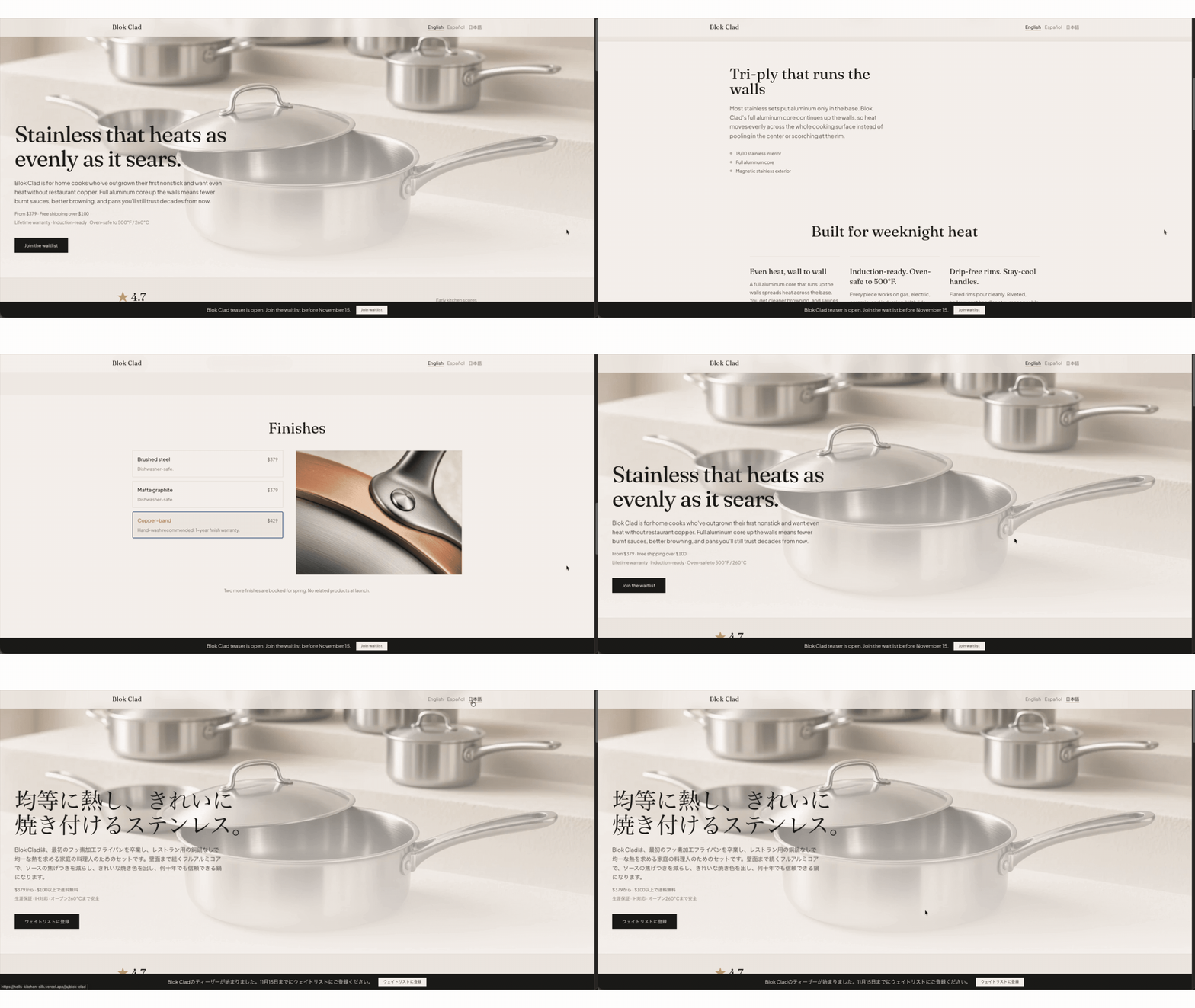
The kitchen used 20,789,167 tokens and made 274 requests to deliver these five things within 30 minutes:
- A live localized teaser page. The Blok Clad landing page on Vercel runs in three locales: /en/blok-clad, /es/blok-clad, and /ja/blok-clad.
- One Storyblok story. The Blok Clad landing page uses the content type
landing_page, alongside 18 other generated blocks.en-USdefault content plus field-level Spanish and Japanese, all published. - A clean schema. Plain names, with the “Quiet Heat” design carried through: sticky teaser bar, graphite waitlist buttons, imperial specs in English, and metric in Spanish and Japanese.
- Four generated product images. Generated and then uploaded to Storyblok with alt-text.
- A complete repo supporting i18n. A github repo that contains a new Next.js project was successfully created and integrated with Storyblok.
Conclusion
Grok Bot gave the kitchen what a staff function needs: bots with their own cloud computers, memory that carries across sessions, and the ability to message each other and hand off work. Instead of asking a chatbot questions or pairing with a copilot, you hand over one brief and get back a localized Storyblok page, which puts the kitchen at the top of the AI maturity curve.
Reaching the top of the curve doesn't mean walking away from the pass though. The bots still needed a human to provide detailed instruction, iteration. And with the help of the human created Storyblok MCP, CLI, and skills, Grok Bot was used to successfully run an Agentic Kitchen that successfully produced a fully working Storyblok application from front to back.
No matter the approach taken to create an agentic kitchen, iteration is key.
And a final message from Grokdon RamseyBot: ”One brief, five bots, ONE plate. And it still took a human to taste it! Iterate, iterate, ITERATE. Now get out of my kitchen and go build your own!”