Salesforce Acquired Contentful: This Is What It Means for Contentful Customers

Storyblok is the first headless CMS that works for developers & marketers alike.
So, your CMS got acquired? Here’s what the Contentful acquisition means for customers like you, and whether it’s worth sticking around.
Acquisitions, by nature, change things. Sometimes drastically, sometimes minimally, but rarely not at all. When the company behind a tool you rely on is integrated into something bigger, it’s logical to evaluate the likely impact and whether the new reality still serves your team, tech, and operations.
If you’re a Contentful customer, you’re probably in this exact position right now. This article will help you understand the details, how it may impact your team depending on your current tech stack, and what might be the best course of action going forward.
The acquisition details
Salesforce announced a definitive agreement to acquire Contentful on June 1, 2026, and completed the acquisition on (opens in a new window)September 1, (opens in a new window)2026 (opens in a new window). As part of this acquisition, Salesforce shared its vision (opens in a new window) to fold the Contentful content management system (CMS) into its Customer 360 and Agentforce ecosystem, creating a native content layer for the Salesforce offering.
This is a major integration. Salesforce's announcement describes Contentful as trusted by over 4,800 brands (opens in a new window). Contentful's own site lists 38,000+ (opens in a new window) supported websites, 550,000+ (opens in a new window) community members, and customers including 30% (opens in a new window) of the Fortune 500.
Salesforce then brings its own scale to the table. It reported $41.5 billion in revenue for fiscal 2026 and describes itself as the world’s #1 AI CRM. Agentforce, the AI agent platform Contentful is being folded into, exceeded $1.5 billion in annual recurring revenue (opens in a new window) in Salesforce’s second quarter of fiscal 2027.
Contentful also isn't Salesforce's only recent move. It joins a string of acquisitions built around AI agent infrastructure, including data-management company Informatica (opens in a new window), announced at approximately $8 billion in equity value, alongside smaller deals for Momentum (opens in a new window), Qualified (opens in a new window), and Cimulate (opens in a new window).
That scale on both sides is exactly what makes this more than a simple bolt-on, in our view. Folding a platform the size of Contentful into a CRM ecosystem of Salesforce's size isn't a lightweight technical lift. It means reconciling two large, mature systems, each with its own architecture, customer base, and roadmap commitments. That complexity is worth keeping in view as we get into what this actually means for you.
Evaluate the Top 10 Contentful Alternatives to help narrow down your choices.
A departure from the product offered
Contentful built its business on an API-first, headless approach that let customers "decide themselves how they want to use their content (opens in a new window)," in the words of co-founder Sascha Konietzke. For many teams, that flexibility was the product: a content layer that could slot into any tech stack they already had, or would put together in the future.
Following the Salesforce acquisition, we believe that’s no longer the full picture. If your team selected Contentful because it didn’t force a stack on you, in our view that part of the decision no longer holds the way it did before. Contentful has said customers remain its top priority and committed to "the same level of innovation, flexibility, and enterprise-grade support (opens in a new window)," and at the time of writing, we haven't seen any public announcement of pricing changes. But who the product ultimately answers to has changed, and with it, we'd argue, how much control you have over your own stack as a Contentful customer.
Salesforce is one of the largest CRM providers, but plenty of organizations run their customer data on something else, whether that’s Microsoft Dynamics, Oracle, HubSpot, SAP, or a homegrown system.
There’s no public figure for what share of Contentful’s own customer base already runs on Salesforce. With so many CRM options in use, we think it’s likely that many Contentful customers now find themselves pairing the CMS they purchased with a CRM ecosystem they didn’t sign up for.
The first question to consider is: what CRM tool does your organization use?
If the answer is not Salesforce and you’re a Contentful customer, that’s the clearest signal of how directly this acquisition will affect your stack and operations. The next thing to consider is whether you want the deeper Salesforce integration that Salesforce has described.
If Salesforce already is your CRM, the picture looks better on the surface. We'd expect fewer integration headaches, content and customer data designed to work together natively, a roadmap likely to favor exactly the use cases you already have. For this group, there's a case that this acquisition is a net positive.
But even here, in our view, convenience today could cost you flexibility and control tomorrow. We expect the overall product roadmap to answer to Salesforce's platform strategy first, whether or not that benefits Contentful customers.
Flexibility requires composability. Learn what that means and the importance of having control over your tech stack in What Is Composable Architecture?
Competing priorities within a larger ecosystem
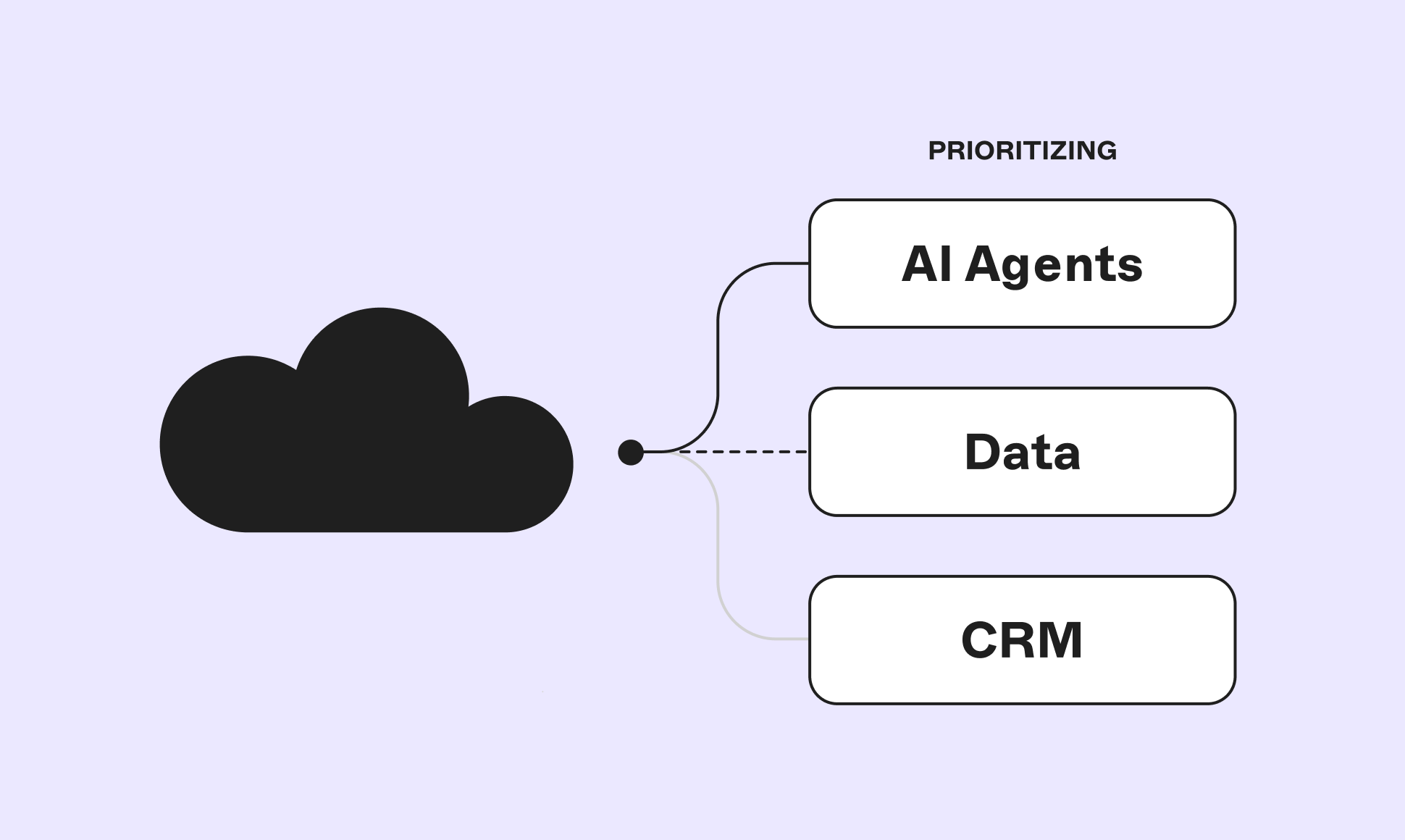
Salesforce has positioned Contentful as a native content layer for its platform, with Agentforce (opens in a new window)able to access its content architecture once integrated (opens in a new window).
Salesforce's own framing makes the shift explicit. Jujhar Singh, President of C360 Applications and Industries, said the acquisition lets Agentforce "dynamically assemble and deliver personalized experiences across every channel, at the speed and scale the AI era demands (opens in a new window)." At the time of writing, Salesforce hasn't published a release date for that capability. In our reading, it shows where investment is headed: toward an AI agent platform, rather than toward CMS use cases equally.
This is a critical point in evaluating the impact on Contentful customers. In our view, Contentful is now one piece of a much larger platform, competing for investment and attention against Agentforce, Data 360, and everything else in the Customer 360 portfolio, alongside whatever comes next. In our experience, once a product serves a parent platform's strategy, its best-supported capabilities become the ones that serve that strategy first.
The question worth asking here is: did you choose it because it was the best content platform available, full stop, or because it was good enough while also fitting your stack?
If it was the former, pay close attention. A vendor whose entire focus was content infrastructure is now one priority among several inside a much larger company. We think that kind of singular focus is difficult to replicate once it's gone, no matter how the rest of your stack lines up. If you valued Contentful for its dedication to content infrastructure specifically, we expect that won't be on offer in the same way anymore, whether or not Salesforce is your CRM.
Read Storyblok vs Contentful: A Technical Comparison for everything they need to know.
Today is the cheapest day to make your decision
"Nothing will change" is the standard message after most acquisitions. In our experience, it tends to hold for roughly 12 to 24 months, after which we'd expect integrations, support, and renewal conversations to start reflecting the parent company's priorities.
That expected timeline is exactly why, in our view, waiting has a cost. Migrating off a standalone CMS today is usually a contained, well-understood project: export the content model, handle redirects, budget the dev time. We find that most of the fear around this process is overstated if you plan it while your systems are still relatively simple.
If deeper Agentforce and Data 360 integration lands as Salesforce has described, we expect that same migration in two or three years could mean disentangling personalization logic and data pipelines that have become woven into the CMS layer. The exit cost, in our view, keeps rising the longer the integration deepens. So if you’re concluding that it’s time to move away from Contentful, we believe today is the cheapest this decision will ever be.
Download The Definitive Migration Guide for a detailed overview of what to expect if you make the switch to the Storyblok headless CMS.
Why your decision matters more now than it used to
Companies that can change their tech easily grow faster than companies that can't. Research from Accenture (opens in a new window), based on more than 4,000 C-suite executives, found that companies with highly interoperable technology grew revenue six times faster than those with low interoperability.
In HLB's 2026 survey (opens in a new window)of 1,113 business leaders, digital and AI capabilities were the most frequently cited organizational weakness (35%), ahead of cybersecurity (29%) and cost and operational management (27%).
This is already playing out around AI search specifically. Storyblok's own research with FT Longitude, surveying 550 senior leaders at companies with at least $1 billion in annual revenue, found that 67% say poor content quality or structure is weakening their visibility in search and AI-driven discovery, and 69% agree that improving their content strategy is more of a technical challenge than a creative one.
Taken together, we think the evidence points one way. Flexible systems are linked to faster growth, digital and AI capability is now the weakness leaders cite most often, and AI search rewards companies whose content is structured to be found. Each of those depends on a content layer you control. That’s why, in our view, your CMS decision carries more weight today than it did a few years ago, and why it’s worth making on your own timeline rather than a parent company’s roadmap.
It’s over to you
In our view, every quarter spent waiting lets the product drift further from the one you originally bought, while the cost of leaving keeps growing. Staying put and hoping for the best outcome may feel like the safe option, but if your tech operations don’t line up with Salesforce’s product strategy, we believe it could wind up carrying a hefty price tag.
If you’re reading this article, you’re likely confirming suspicions about what this type of acquisition means for your team, or you’re still on the fence about whether to stick or switch. If there is one takeaway from this piece, it’s this: make the decision that’s best for your team, and make it as quickly as is feasible.
We expect the teams in the best position a year from now will be the ones who looked at this clearly today, rather than waiting to see what happens. Your tech stack is the foundation everything else gets built on; it deserves to be treated like one.
Salesforce®, Contentful®, and Agentforce™ are trademarks of their respective owners. Storyblok is not affiliated with, sponsored by, or endorsed by Salesforce or Contentful.