What Enterprise Asset Management Should Actually Look Like

Storyblok is the first headless CMS that works for developers & marketers alike.
When your organization runs multiple teams, brands, or regions, asset management quietly becomes one of your biggest operational headaches. At the end of the day, most setups weren't designed for the way enterprise content teams actually work. So, yes, the result is familiar: the same asset uploaded in multiple places, brand images that drift between teams, a rebrand that turns into a weeks-long coordination effort, and an org-wide asset audit that's been on the backlog for six months.
In this article, we'll break down why enterprise asset management keeps breaking down at scale, what a better architecture looks like, and how the Storyblok Enterprise Assets Library addresses it, directly inside your CMS.
Why enterprise asset management breaks down
Most enterprises think they have an asset problem, when instead it’s their architecture that’s slowing them down. When assets are created centrally but managed locally, every team and every region ends up with its own copy of the same files… slightly different, slightly out of date, with no reliable way to know which version is current. It’s the classic example of governance existing on paper but falling apart in practice because the tooling doesn't support it at scale.
The symptoms are predictable:
- Assets are duplicated across properties, teams, and regions with no single source of truth
- Brand consistency that depends on people remembering to check rather than systems enforcing it
- Permissions that are either too open or too restrictive, with nothing in between
- Updates and rebrands that require manual coordination across every property that might be using an affected asset
This is exactly what happens when asset management is treated as a property-level problem instead of an organization-level one.
What centralized asset management actually means
A lot of us associate centralized with locked down. But that’s not the case. The goal of centralizing is to make the right assets easier to find, use, and trust.
In practice, centralized asset management means:
- One library, available everywhere it's needed.
Assets live at the organization level and flow to the properties, teams, and regions that need them. You end up eliminating duplication and manual distribution. - Governance that matches how your organization is structured.
Different teams need different levels of access: read-only for some, full editing rights for others. Plus, regional libraries for organizations operating across markets. The system should reflect your structure. - Consistency you can rely on.
When there's one source of truth for every asset, brand consistency becomes a natural outcome of how the system works. - Reuse without the overhead.
Upload once, use across every property that needs it. When something changes, it changes once, and that update is visible everywhere.
The case for keeping assets inside your CMS
Here's where most enterprise setups create unnecessary complexity: they treat their Google Drive or their DAM and the CMS as separate systems. Assets live in one platform, content lives in another, and teams spend their time moving between them: downloading, re-uploading, cross-referencing, hoping nothing gets lost in translation. And it doesn't have to work that way.
When asset management lives inside your CMS, the distance between "finding the right asset" and "using it in content" disappears. At the end of the day, the CMS is already where content decisions happen. And since assets are part of those decisions, they should be in the same place and organized so there is one place to find them and one version to trust. A DAM that lives inside your CMS, governed at the org level, is the architecture that matches the complexity of how enterprise content teams actually operate.
Enterprise Assets Library in Storyblok
Storyblok has always had a built-in Digital Asset Manager, assets and content in one place, by design. The Enterprise Assets Library extends that to the organization level, built specifically for teams managing assets across multiple Spaces, brands, and regions.
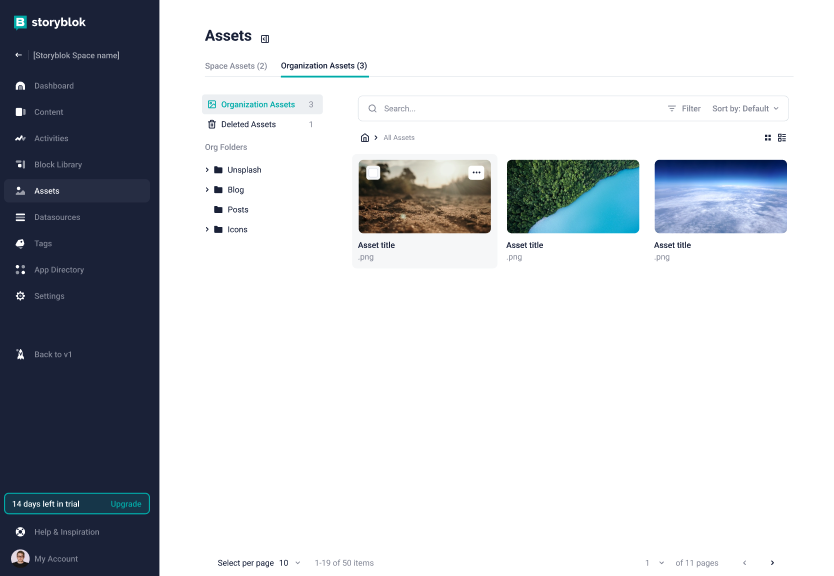
- Shared Asset Libraries: Create and manage asset libraries at the org level. Organize by region, brand, or team. Make them available to selected Spaces with defined permissions.
- Shared Asset Manager: A dedicated org-level interface for creating libraries, configuring permissions, managing metadata, and tracking activity across your entire organization.
- Built into the DAM you already use: Shared Libraries appear as additional tabs inside the existing Space Digital Asset Manager. Content editors access shared assets exactly where they already work. No new tools, no new workflow.
- Full asset functionality at the org level: Full asset functionality at the org level: Upload, edit, organize, tag, and track. Everything available at the Space level is now available organization-wide.
- Permissions and governance built in: Read-only or edit access at the library level, metadata configuration, and activity tracking, giving enterprise teams the control they need without the operational overhead.