Marketer and Developer Collaboration: 6 Ways to Work Better Together

Storyblok is the first headless CMS that works for developers & marketers alike.
- Dive deeper. Get the full guidebook on how to break the unhealthy dependency between marketers and developers (opens in a new window).
- Supercharge your content delivery with the CMS built for all teams. See how Storyblok can revolutionize your collaboration today. (opens in a new window)
Modern content systems are only getting more powerful. That’s great news for content strategy, but it also means the tech behind it is getting increasingly complex. Leveraging its full value will depend on how well marketers and devs can collaborate as one cohesive team.
But let’s be honest – that’s easier said than done. Marketers and developers might work towards the same goal, but they’re almost always operating with different priorities, timelines, and tools. Unless you employ the right structure and strategy, you'll be stuck with the slow publication times, lower content velocity, and innovation limits that come with clashing.
Fortunately, there’s a better way. By applying a few best practices, you can ensure seamless collaboration that transcends the marketer/developer divide for faster launches, healthier content, and better performance.
Marketer-developer collaboration: 6 ways to work better together
Let’s dive right in. Here are six ways to work better with your devs.
Not sure where to start? Consider your current collaboration woes. If you primarily have trouble communicating, for example, learning the language (#4) will make a big difference – but if performance is tanking, it might be better to begin with content health (#2) or metric alignment (#6).
1. Understand your content system
You can’t have a productive conversation about a topic you’re not familiar with. By taking steps to understand your CMS and any content stack additions, you’re making sure both teams are on the same page. Requests can be more realistic, and you can discuss ideas with devs in more depth.
Start by expanding your technical understanding of critical concepts, such as:
- Content models (opens in a new window) (if in use)
- APIs and what they’re connecting to
- Your Digital Asset Manager (DAM)
- Any workflows in place
You don’t have to become an expert. Even a basic understanding can go a long way to helping you work better together! As a bonus, you might even discover new capabilities just waiting to be leveraged.
Not sure where to start? Ask your devs! A few conversations about your shared content system can be enough to reduce bottlenecks, clarify expectations, and cut wasted time.
2. Prioritize content health
Content health (opens in a new window) refers to general accuracy, relevance, structure, and scalability of your content across all channels. It determines how well your content performs, adapts, and remains aligned with your business goals.
Safe to say, it’s a pretty big deal.
When content health wanes, companies feel the pain: scaling gets more difficult, performance tanks, and AI visibility (opens in a new window) decreases. Your dev relations take a hit, too: unhealthy content creates an unnecessary technical workload, forcing them to spend more time fixing than innovating.
Make sure content health is a metric you’re monitoring closely – and don’t forget to involve the devs! They can provide a lot of site and performance data to make your efforts more targeted and effective.
Want to learn more about improving your content health? Check out The Marketer’s Road to Content Health in 2026 for a practical guide.
3. Use collaboration tools designed for both teams
Collaboration can be tricky when you’re working together, but have different viewpoints and priorities. The easier it is to communicate with the tools you use every day, the more those silos break down.
When you’re shopping for content tools, prioritize the ones that:
- Include version tracking so all changes are traceable and accounted for
- Allow structured content models to improve and maintain content health
- Give the option to require approval stages where necessary
Of all the tools in a content stack, take the most care with choosing your Content Management System (CMS) (opens in a new window). It’s the engine of your strategy and defines the type of work your dev teams will do.
It’ll ultimately come down to your specific needs, but there are a few features that tend to support both teams no matter what:
- Role-based permissions to avoid accidental changes
- Visual editors with live previews to support editor independence
- Workflow automations to save time across all teams
No matter what, make sure to choose a CMS that both teams can happily agree on. It’ll save everyone a lot of headaches down the road.
Try to have at least one marketer and one dev in any procurement process for a tool that could impact both teams. It’s a lot easier to agree on a good fit from the start than to try to force a bad fit to work.
4. Speak the same language
Collaboration becomes a thousand times easier once you’re speaking the same language. Learning some essential dev terms will make your conversations smoother, faster, and more enjoyable for everyone.
You don’t have to take up coding to hold a conversation. Even if you don’t get the technical minutia, just having an understanding of a few terms can really make a difference:
- APIs: Application Programming Interfaces are the software intermediaries that allow different programs to communicate, exchange info, and work together.
- Deployment: The final phase of launching for devs – the moment they hit their own “publish” button and make their updates live.
- Technical debt: Outdated, messy code or technology that gets the job done but slows things down and prevents growth.
Get the full dictionary for dev-marketer communication in our blog article Demystifying Developer Language: A Marketer’s Guide.
5. Reduce developer dependency
If you’ve ever had to create a ticket so a dev could make a tiny content change, you know how important this is. The more you can work independently, the less you’ll need to rely on devs to do your job, saving everyone time and friction.
One way to do this is to choose tools that consider the marketing experience as well as the dev experience. A CMS that offers a Visual Editor (opens in a new window), for example, will empower you to make content changes independently. Plus, devs can create reusable components for marketers, allowing them to quickly leverage reusable content that can still be customized without risking any technical errors.
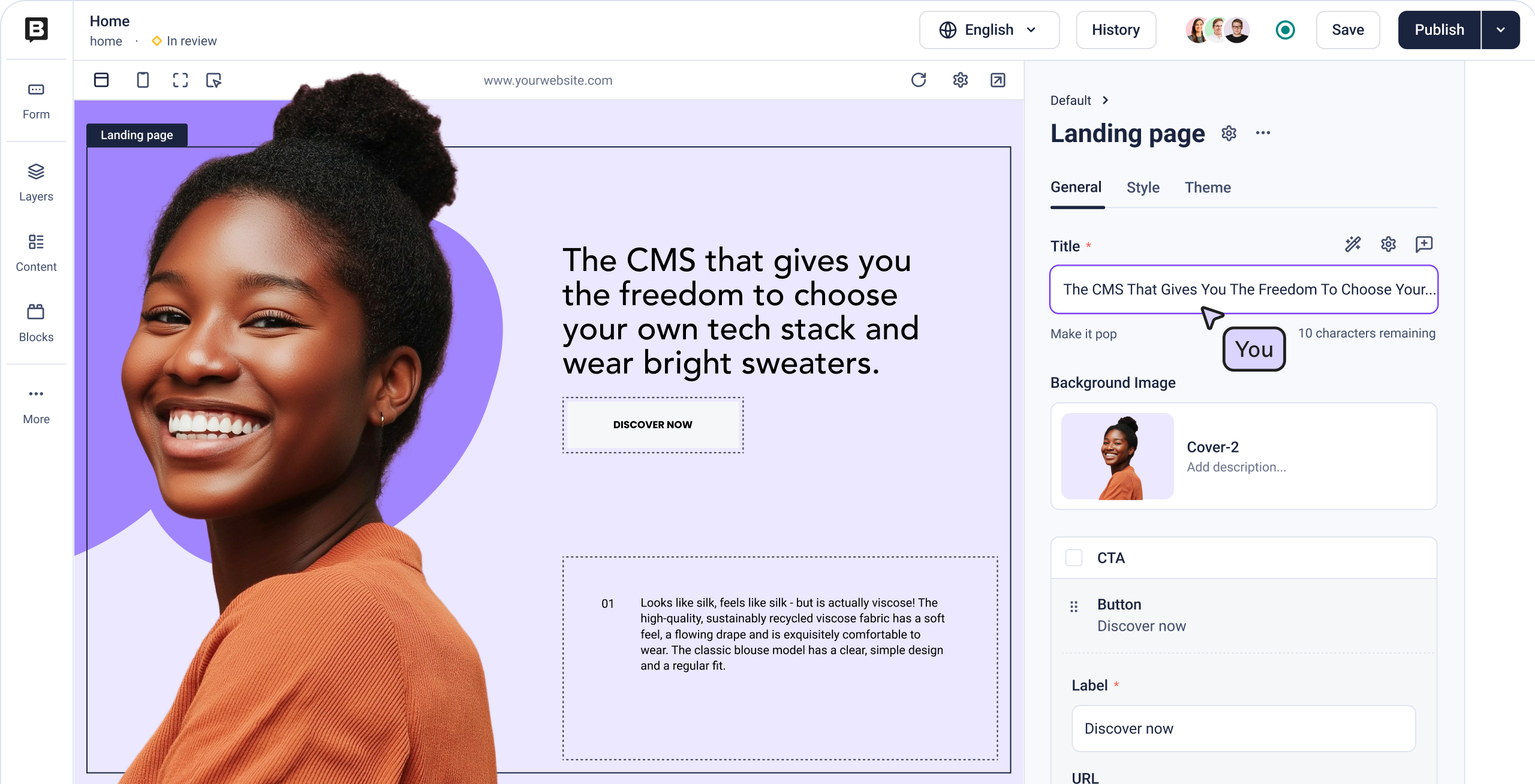
You get more autonomy to do your job, they get a lighter workload, and everyone wins! But there’s one important caveat to striking out on your own: if your devs give you a guard rail, listen to them. There are some places on the backend of your website that even the most tech-savvy marketers shouldn’t go – at least, not without a discussion first.
Learn more about how a headless CMS can help foster cross-functional teamwork in the IDC report, Unlock Content Collaboration and Agility with a Headless CMS for Marketers, Developers, and Digital Teams.
6. Align around the same metrics
Devs and marketers are two essential teams working together to create digital experiences. For all the differences, it’s still one team. Aligning around a few of the same metrics that support that goal can help clarify where you can work best together and bring more context to your collaborations.
Start with what you have in common. Marketers generally care about traffic and conversions, while developers are more concerned with stability and performance. A few shared metrics that speak to both sides could include:
- Page performance
- Content velocity
- Website reliability
When there’s a specific shared goal to focus on, you’ll find that collaboration is more seamless and mutually beneficial.
Key takeaway: One team, not two
It’s no secret that devs and marketers work in very different worlds. But when those teams find some common ground, focus on shared goals, and keep open lines of communication, something magical happens. Work together well, and the final product will be worth far more than the sum of your parts.