Why teams prefer Storyblok to Contentstack
Storyblok was built around a visual editor from day one. For Contentstack, it was an afterthought.
In a world where AI synthesizes your content before customers ever reach your site, your editorial team needs a CMS designed for their independence, not one that arrived at it late.

Storyblok outperforms Contentstack where it counts
G2 reviewers don't care about pitch decks. They rate what they experience, and across the categories that matter most for enterprise content delivery, Storyblok comes out ahead.






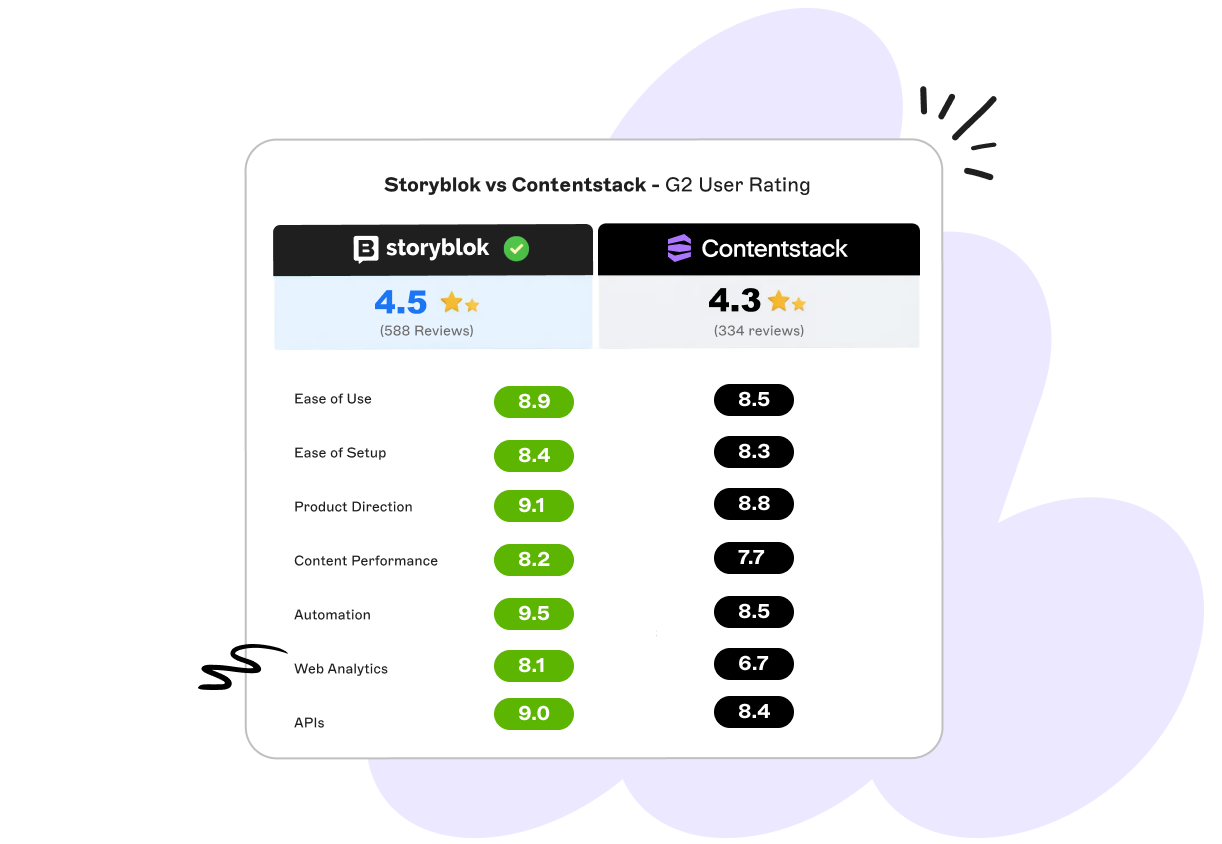
Verified by the people who actually log in
When enterprise teams compare Storyblok and Contentstack on G2, a pattern emerges across every category that connects to AI-era content delivery.
These ratings are from verified G2 reviewers – product managers, developers, and content editors who chose between these two platforms and live with that decision daily.
Storyblok (570+ Reviews) | Contentstack (300+ Reviews) | |
|---|---|---|
G2 2026 Software Awards | #1 Headless CMS 👑 | Not listed 😬 |
Average ROI | 11 months | 13 months |
Content Performance | 8.2 | 7.7 |
Product Direction | 9.1 | 9.0 |
Automation | 9.5 | 8.5 |
Ease of Use | 8.9 | 8.5 |
Ease of Setup | 8.4 | 8.3 |
APIs | 9.0 | 8.4 |
Web Analytics | 8.1 | 6.7 |
Here's what editorial independence looks like
Storyblok is built on a simple belief: content has to work for everyone who touches it, not just the engineers who configure it.
According to an independent study, 83% of users describe the experience as joyful.
Developers get clean APIs, framework freedom, and a component model they can build exactly as they like. Content teams get a Visual Editor with real-time front-end preview, publishing independence, and the tools to move at the speed of the business.
Contentstack is built to publish content.
Storyblok is built to help you trust it.
Your customers are already getting answers about your brand before they've ever visited your website. Whatever your organization has published, AI synthesizes and presents as fact. AI doesn't filter out what's outdated, contradictory, or unstructured — it just uses it. And that's not a problem Contentstack was built to solve.
-
Content Observability
You can't govern what you can't see. Storyblok's Flowmotion helps your enterprise get visibility into what's drifting, outdated, or contradictory across your entire content estate. -
Structured Content Architecture
Storyblok's component-based model organises content as structured, reusable blocks. Combined with the MCP Server, which gives AI agents direct, typed access to your content, it means AI reads your content accurately rather than reconstructing meaning from page output. -
Content Operations at Scale
FlowMotion brings 500+ integrations into the content lifecycle, sequencing actions, enforcing governance rules, and routing across markets automatically.
-
AI-Ready Content Foundation
Storyblok's MCP Server connects AI agents directly to your content infrastructure with structured access to read, write, and manage content without custom wiring. Your content estate becomes immediately agent-ready, not something to retrofit later. -
Editorial Independence That Scales
Contentstack's 76% self-service score reflects a real architectural reality: editors depend on developers more than they should. Storyblok's Visual Editor removes that dependency, so content stays current without the ticket queue. -
Enterprise-Grade Governance
We're ISO 27001 and TISAX-certified and uphold strict international standards for information security and data protection.
Enterprise teams that made the move
Check out what our customers who migrated to Storyblok have to say, and find out what they've built since.

Odido
With Storyblok, Odido pulled off its rebrand at full scale, under pressure, and without a second of downtime. What could have been chaos became the ultimate stress test and a showcase of stability at scale.





The feeling is mutual
Three of the industry's most impartial voices, one common conclusion:

Storyblok stands out for its flexible architecture, intuitive editing experience, and enterprise scalability.

Storyblok was recognized for its visual editor, content authoring, API coverage, and next-generation features.


Your step-by-step guide to migrating successfully
This in-depth guide walks you through every stage of the migration process, from initial scoping and content modeling, all the way through validation, post-launch as well as SEO and AI search optimization.
Extra resources to help you get started
Explore technical guides, migration patterns, and product comparisons to support your move to Storyblok. Whether you are planning your approach or already migrating, these resources help you move faster and with fewer surprises.
-
-
Migration Documentation
Dive into our developer docs, covering importing content, mapping fields, asset handling, deployment and more. Use this as your source of truth when planning or validating migration steps.
-
Where to Start?
Learn what a CMS migration involves and how to build a website content migration plan that minimizes risk and maximizes ROI.
-
Technical Comparison
Storyblok offers a modern alternative to Contentstack that makes it easier to deliver content at scale and maintain a strong customer experience. View for a deeper technical comparison.
-
Storyblok Discord Community
Connect with peers and Storyblok experts to exchange ideas, discuss challenges, and share best practices around migration projects.
-
-
Storyblok enabled us to achieve a multi-million-pound annual saving, streamlining and centralizing multiple platforms and use cases into one.


Frequently Asked Questions
-
01 What is the main difference between Storyblok and Contentstack?
Storyblok and Contentstack are both enterprise headless CMS platforms, but they differ fundamentally in editorial philosophy and AI-era readiness. Contentstack is a developer-centric platform designed around engineering-managed content pipelines, with editors working in a structured back-end interface and previewing content in a separate environment.
Storyblok's Visual Editor gives editorial teams real-time, in-context editing — the same view visitors see, before anything goes live. Beyond the editing experience, Storyblok's component-based content model is architecturally better suited to structured, AI-ready content delivery — creating a semantic layer that AI systems can interpret accurately rather than infer from entry-based output.
-
02 Is Storyblok a strong Contentstack alternative for enterprise teams?
Yes. Storyblok is rated the #1 Headless CMS on G2 Summer 2026 with 572 verified reviews. Enterprise teams switching from Contentstack to Storyblok most commonly cite the following differences: faster average go-live time (3 months vs Contentstack's 4), shorter ROI payback period (11 months vs 13), stronger editorial independence through the Visual Editor, and a content model better suited to the structured, componentized content architecture that AI-era delivery requires. Storyblok is ISO 27001 and TISAX certified and offers fully customizable Premium and Elite enterprise plans.
-
03 What is "Content Confidence" and how does it relate to choosing between Storyblok and Contentstack?
Content Confidence is the strategic capability to know that your content is accurate, structured, observable, and aligned with your narrative — across all channels, at all times. It matters in this comparison because Contentstack's AI offering (Copilot) is focused on content creation — generating content faster.
Storyblok's approach addresses the fuller problem: whether the content your organization has already published is accurate, well-structured, and ready to be ingested by the AI systems that now mediate customer discovery. The two approaches address different stages of the content lifecycle, and for enterprises where AI-mediated discovery is a strategic concern, the distinction matters significantly.
-
04 How does Storyblok's Visual Editor compare to Contentstack's editing experience?
Contentstack is an API-first headless CMS — editors create content in a structured back-end interface and preview it through a separate preview environment, which is standard practice for developer-centric headless platforms. Storyblok's Visual Editor provides in-context, real-time editing: editors see what visitors will see, make changes in that view, and publish — all in the same interface. No separate preview step. This is a meaningful architectural difference, not just a UX preference.
-
05 How does Storyblok's content model differ from Contentstack's, and why does it matter for AI?
Contentstack organizes content using "content types" and "entries" — a well-established headless CMS pattern where content is structured for output delivery. Storyblok uses a component-based content architecture where content exists as reusable, composable blocks with semantic meaning attached. This difference matters significantly for AI: structured, component-based content gives AI systems a clear semantic layer to interpret accurately, rather than requiring inference from page-level output. When enterprises begin vectorising their content — converting it into mathematical representations that power semantic search and ground AI reasoning in real enterprise knowledge — the quality of the underlying content model determines the quality of the result. Storyblok's architecture is built for that.
-
06 How does Storyblok's pricing compare to Contentstack for enterprise?
Both platforms offer enterprise pricing that scales with organizational needs. Storyblok's Premium and Elite plans are fully customizable — designed around what your organization actually uses rather than tier structures that create cost surprises at growth moments. Contentstack's pricing is also enterprise-negotiated, though its implementation model — which often requires more significant developer involvement for setup and maintenance — can add indirect cost that doesn't appear in the license comparison.
Ready to start? Joy awaits.
Find out yourself why Storyblok is rated the #1 Headless CMS.