Which CMS is Best for AI Search? Adobe Experience Manager (AEM) vs Storyblok

Storyblok is the first headless CMS that works for developers & marketers alike.
Quick answer
Storyblok (opens in a new window) is generally the better fit for AI search because its component-based structure produces clean, machine-readable content by default. Adobe Experience Manager (AEM) can produce the same kind of structured content through Content Fragments and GraphQL, but that structure sits on top of a page-based system built for traditional web publishing, so it usually takes more setup and specialized skills to get there. If your organization already runs on Adobe Experience Cloud and needs hybrid rendering across many products, AEM's ecosystem may outweigh the extra setup. If you want a lighter platform built around structured content from day one, Storyblok is the more direct route.
Is AEM or Storyblok better for AI search?
AI search has changed how people find information, and that shift puts new pressure on the systems brands use to manage and distribute their content. The question is, which content management system (CMS) platform helps you show up in the answers you want to faster? In particular for this article, is AEM or Storyblok the right choice for your team?
Storyblok stores content as reusable components from the start. AEM was built as a page-based CMS and added structured content later, through Content Fragments and GraphQL. Both can produce AI-readable content, but Storyblok generally takes less setup and less specialized skill to get there, while AEM usually needs developers who know its Java-based architecture well.
But enough of the high-level analysis. Let's dig into the details.
- What AI search looks for in content
- What is structured content, and why it matters
- AEM vs Storyblok at a glance
- Cost and timeline factors to consider
For a full breakdown of how AI-powered search works and how content gets pulled into AI answers, read What AI Search Means for Your Content Strategy
What AI search looks for in content
AI systems reward the same qualities regardless of which CMS produces the content:
- Structured, well-modeled content that separates data from presentation
- Fast-loading pages, since slow sites get crawled and surfaced less favorably
- Signals of expertise and trustworthiness, echoing Google's EEAT guidance (opens in a new window) (Experience, Expertise, Authoritativeness, and Trustworthiness)
- Freshness and accuracy, since outdated or contradictory content undermines an AI system's confidence in a source
- Consistency across channels, since AI systems pull from multiple brand touchpoints, not just a website
Storyblok's AI Readiness Assessment benchmarks your content operations against these criteria in under 15 minutes and flags specific gaps to close, regardless of which CMS you're currently running.
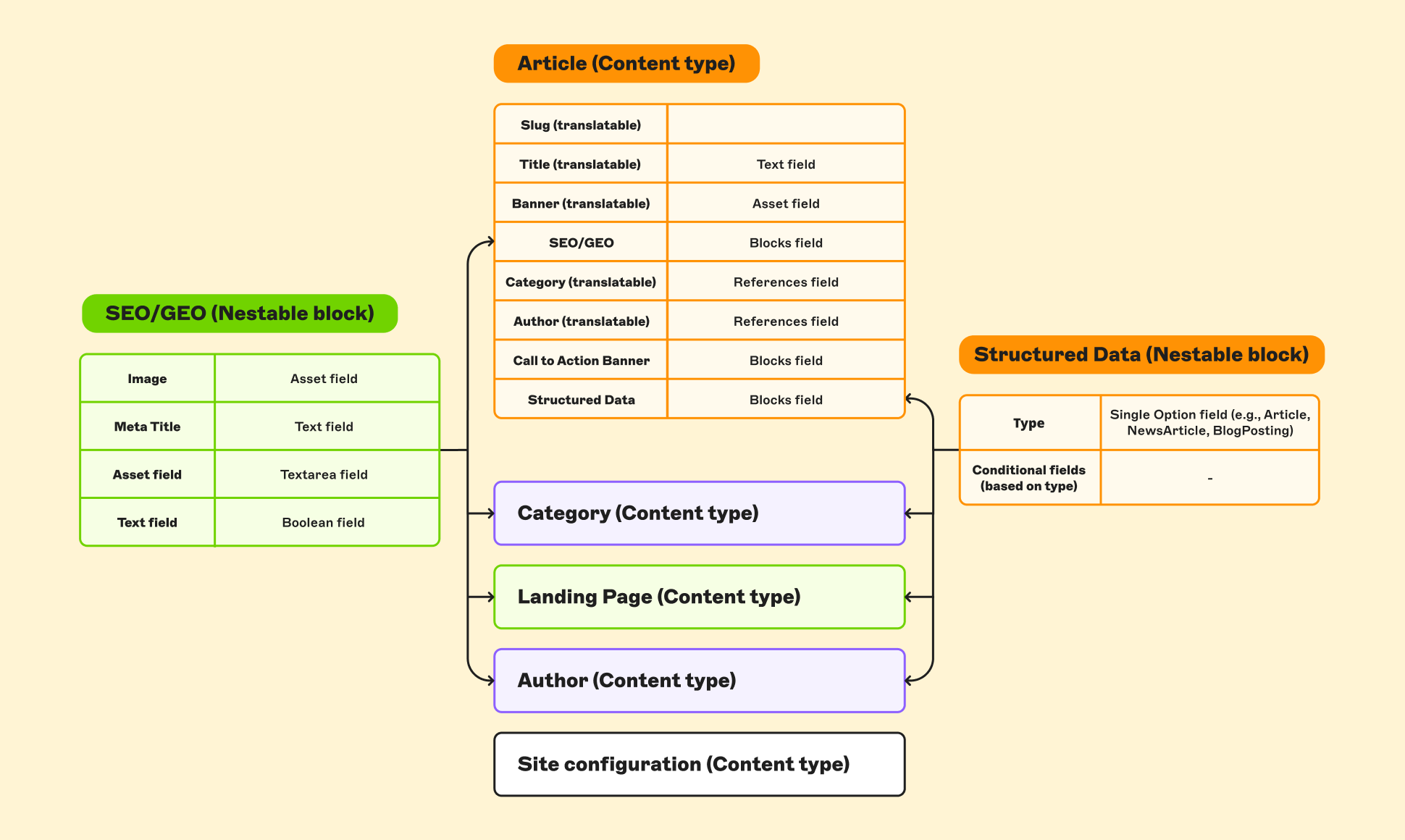
Structured content refers to organizing information into defined fields and components. It's distinct from structured data (like schema.org markup), which sits on the presentation layer for search engines to read. Content modeling is what helps create that structure for the AI agents reading it: defining content types (Blog Post, Product, Author) and their fields upfront, so every piece of content comes out consistent and easy to turn into clean, machine-readable data.
AEM and Storyblok take different paths to the same goal. AEM adds structure onto a page-based system through Content Fragments and GraphQL. Storyblok is built around structure from the start, with every piece of content stored as a reusable, nestable component.
We got you. Here are some handy guides:
- Content Modeling, Explained: A practical walkthrough of the modeling process
- Content Modeling documentation: A technical reference for developers and content architects
Adobe Experience Manager (AEM) | Storyblok | |
|---|---|---|
Architecture | Page-based, Java/JCR foundation with hybrid and headless options added on top | Headless-first, component-based from the start |
Structured content | Available via Content Fragments and GraphQL endpoints | Native, built into every content type and component |
Setup for AI-readable content | Typically needs specialized configuration and AEM-specific expertise | Generally faster to set up, less specialized configuration needed |
Best fit | Large enterprises already using Adobe Experience Cloud and needing hybrid rendering | Teams that want a lighter, composable CMS focused on content structure, flexibility, and scalability |
Editor experience | Mature, but tied to traditional page-authoring workflows | Built for non-technical editors managing reusable blocks |
Ecosystem | Deep integration with Adobe Experience Cloud (Analytics, Target, Firefly, GenStudio) | Extensive and growing app directory and API-first integrations with any front end |
Take a look at this dedicated technical comparison for a closer look at architecture, tooling, and implementation differences.
This table is a great starting point for understanding what both AEM and Storyblok have to offer your AI search goals. The right answer for your organization depends on your existing stack, your team's technical depth, and how much of your content already lives in Adobe products.
AEM's approach to AI-readable content
AEM supports structured content through two main mechanisms:
- Content Fragments, which let teams define reusable, channel-agnostic content models separate from page layout
- GraphQL APIs, which expose that structured content to any front end or, in principle, to an AI system parsing the page
The tradeoff is that both sit on top of AEM's original page-and-component architecture, which was designed for authoring web pages long before API-first content delivery became a priority. Getting the most out of Content Fragments and GraphQL in AEM generally requires developers who understand the platform's Java-based foundation, its JCR content repository, and Adobe's specific implementation patterns. For organizations with an existing AEM investment and a team who knows the platform well, this is a manageable, well-supported path. For teams without that specialized skill set, it adds time and cost before structured content actually ships.
AEM's strongest argument is its ecosystem. Organizations already using Adobe Experience Cloud products such as Analytics, Target, Firefly, or GenStudio get tighter integration by staying inside Adobe's stack, and AEM supports hybrid rendering for teams that need both traditional pages and headless delivery from one platform.

Storyblok's approach to AI-readable content
Storyblok's content model is component-based by default. Every piece of content, from a hero banner to a product spec, is built as a nestable block with defined fields. That structure exists whether or not a team sets out to build for AI search, because it is how the platform stores content in the first place.
This generally means:
- Less custom configuration to produce clean, structured output
- Content models that non-technical editors can build and maintain without engineering support
- An API-first delivery layer that works with any front end, which also makes it easier to keep content consistent across a website, app, and other channels
That same API-first foundation is also what makes Storyblok's AI tooling possible. Storyblok also offers built-in AI tooling as part of its live product line. The AI Suite includes features like automated alt text generation for images and on-page AI SEO guidance, all managed inside the Storyblok interface. AEM's AI investments, through Firefly and GenStudio, are focused on creative asset generation rather than content structure or discoverability tools built into the CMS itself.
Storyblok's tradeoffs are real too. Its flexible model, like any composable system, needs disciplined setup from day one, or governance problems can accumulate over time.
Migration risk: What to weigh before switching
If you are considering moving from AEM to Storyblok, or evaluating either platform from scratch, weigh these practical risks alongside AI search readiness:
- Content loss during extraction: Pulling structured content out of AEM's JCR repository without thorough validation can drop or corrupt fields.
- Broken URL equity: Incomplete redirect mapping during a platform migration can damage existing organic search rankings, which takes time to rebuild.
- Governance gaps: Neither platform solves governance automatically. AEM's Multi-Site Manager provides structured content inheritance but can become rigid as complexity grows. Storyblok's model is more flexible but depends on disciplined setup.
- Implementation expertise: Both platforms benefit from an experienced implementation partner at enterprise scale, whether you are staying on AEM or migrating to Storyblok.
Migrating off AEM doesn't have to mean replacing your entire Adobe stack. Tools like Adobe Analytics, Target, or Experience Platform connect to most modern CMS platforms, including Storyblok, via API. The decision to change your CMS and the decision to change your broader marketing stack are separate and can happen on separate timelines.
Cost and timeline factors
Beyond AI readiness, three factors typically drive the AEM vs Storyblok decision:
- Total cost of ownership. AEM costs typically span licensing, hosting, developer time, and agency support, and tend to scale with enterprise complexity. Storyblok offers a free tier for proof-of-concept work and pricing that scales with actual usage rather than fixed enterprise tiers.
- Time to launch. Storyblok's headless-first setup and prebuilt component patterns generally shorten initial build time. AEM implementations, especially ones setting up Content Fragments and GraphQL for the first time, typically take longer to configure properly.
- Team skill requirements. AEM's page-based, Java foundation often means maintaining separate builds for web and other channels, which adds engineering overhead. Storyblok's API-first approach works with common front-end frameworks like Next.js, Nuxt, React, Vue, and Astro, so there's no dual-build step and a wider pool of developers can work on it.
Your CMS is the foundation AI search will test first
Headless is quickly becoming the standard for brands that want to stay visible as AI search reshapes discovery. Storyblok's structured, API-first content gives it a natural edge here, while AEM's strength lies in its deep Adobe ecosystem and enterprise-grade rendering options. The right choice still depends on your team's scale, technical resources, and existing investments. But as AI search puts more pressure on how content is structured and delivered, the platform you build on matters more than ever.
The question worth asking is simple: Is your CMS ready for what AI search demands next?
Explore Storyblok vs Adobe Experience Manager and discover why Storyblok is rated the #1 Headless CMS.
Frequently asked questions (FAQs)
Is AEM a headless CMS?
AEM supports headless delivery through Content Fragments and GraphQL APIs, but it was originally built as a page-based CMS. Adobe has added headless and hybrid capabilities on top of that foundation, rather than starting from a headless architecture.
Is Storyblok better than AEM for AI search?
Storyblok generally requires less setup to produce AI-readable, structured content because that structure is built into its architecture by default. AEM can produce comparable structured content through Content Fragments and GraphQL, but typically needs more specialized configuration to get there.
Can AEM and Storyblok both produce structured content for AI search?
Yes. Both platforms can produce structured, machine-readable content. Storyblok is built around structure from the start, while AEM layers structured content capabilities onto a page-based system.
What should I check before migrating from AEM to Storyblok?
Validate content extraction from AEM's JCR repository, map redirects carefully to preserve existing search rankings, and plan governance for your new content model before migrating, rather than after. For a step-by-step walkthrough, see Migrating AEM Content Structures to a Flexible Content Model in Storyblok.